
What Is Measurement Architecture?
Measurement architecture defines what data analytics collects and what optimization algorithms follow. It directly affects what systems can detect and what they begin to optimize.
What is measurement architecture?
Measurement architecture is the framework in which Consent Mode v2, Google Tag Manager (GTM), and Google Analytics 4 (GA4) determine how data remains available, how a signal is formed, and what that signal means in business terms. The goal is not just to collect data, but to create an optimization signal that steers decisions and automation in the right direction.
What will you get from this page?
This page gives you a clear model of measurement architecture and its three layers: availability, control, and meaning. It also shows how these layers work together to produce an optimization signal that guides decisions, budget allocation, and automation toward the right outcome.
The layers of measurement architecture
In measurement architecture, the business objective must be translated into a signal that remains available within the limits of consent, is generated in a controlled way, and carries the right business meaning. Only then does an optimization signal exist that can be used in decision-making, budget allocation, and automation without causing the system to optimize the wrong thing.
- Availability — Consent Mode: How the signal remains usable within the boundaries of consent and privacy.
- Control — Google Tag Manager (GTM): Where the signal is generated and how to prevent errors that distort reporting and optimization.
- Meaning — Google Analytics 4 (GA4): How you define conversions and value so that budget allocation and automation aim toward the correct outcome.
Why is measurement architecture important?
Measurement architecture determines what kind of signal remains available for decision-making and automation. It defines what systems are able to observe, what they interpret as important, and what they begin to optimize. If the architecture is weak, systems may optimize something that is measured correctly but is still wrong from a business perspective. That is why measurement architecture is not just a technical implementation. It directly affects what budget allocation and automation begin to favor in practice.
If one layer of your measurement architecture failed today, would you see it first in budget allocation or only later in reporting?
Where should you start?
Start with the layer where the signal is most likely to break down. If data is lost because of consent restrictions, start with availability. If the signal is generated incorrectly or inconsistently, start with control. If the data appears in reports but fails to steer budget and automation toward the right outcome, start with meaning.
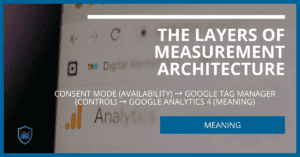
The Layers of Measurement Architecture
Consent Mode (availability) → Google Tag Manager (control) → Google Analytics 4 (meaning) = optimization signal


Google Tag Manager – Signal control
Signal control How to manage the technical origin and quality of data

Google Analytics 4 – Signal meaning
Signal meaning How to turn raw data into conversions and decisions
Optimization Signal
When availability, control, and meaning come together, an optimization signal is formed
The optimization signal determines what algorithms learn, what kind of traffic they begin to favor, and where budget is allocated.
How do you know that measurement is guiding algorithms correctly?
Measurement guides algorithms correctly when three conditions are met simultaneously: the conversion represents the correct outcome, the value distinguishes profitable outcomes from unprofitable ones, and the signal remains usable within consent constraints. If any of these fails, reports may still appear “reasonable,” but automation may optimize the wrong objective.
What does a good measurement architecture enable?
When availability, control, and meaning are properly implemented, budget allocation and automation begin to follow business value rather than simple volume. In practice, this appears as optimization favoring higher margins and higher-quality outcomes, even if the total number of conversions remains unchanged.
How does a properly implemented measurement architecture work?
Reports may appear understandable even when advertising algorithms are optimizing the wrong objective. Simply installing Google Tag Manager (GTM) tags is not sufficient to achieve business objectives.
A properly implemented measurement architecture does one thing well: it translates a business objective into a signal that budget allocation and automation can optimize correctly. It ensures three conditions: the signal remains usable within consent and privacy constraints, the signal is generated in a controlled way in the collection layer, and the signal’s meaning (conversion and value) reflects profitability rather than simple volume.
What is business-quality measurement?
Business-quality measurement distinguishes value: profitable and unprofitable outcomes do not appear as the same signal. Conversion and value are defined so that they represent the correct outcome (for example margin or customer quality), rather than just volume. Measurement architecture supports this by ensuring that the signal remains usable within consent constraints, is generated in a controlled way, and is recorded correctly. As a result, budget allocation and automation can optimize for profitability rather than simply increasing the number of equal-value conversions.
How does measurement architecture support measurement?
A properly designed measurement architecture begins with the company’s business objectives. The following examples illustrate use cases where the technical implementation is often relatively simple, but the business objectives embedded in the models differ significantly.
Example of inadequate measurement: In an ecommerce environment, every “order” is treated as an equally valuable conversion. In this situation, discounted products and low-margin orders dominate optimization because they generate many conversions—even if the overall outcome, namely contribution margin, declines.
Example of effective measurement: In an ecommerce environment, an “order” remains the conversion, but the value of the conversion is not the same for all orders. Each order is assigned a margin-based value (for example contribution margin or a margin coefficient), which reduces the signal impact of discounted and low-margin orders relative to full-price and healthy-margin orders. As a result, budget allocation and automation begin to favor traffic and products that produce stronger margins—even if the total number of orders does not increase.
What does this require from measurement architecture?
For margin-based value to actually guide optimization, the signal must remain usable within consent constraints, be generated correctly in the collection layer, and be stored in Google Analytics 4 (GA4) results so that conversion and value remain consistent throughout the entire chain.
Recent articles
Why Google Analytics 4 Can Lead to Poor Decisions
Is your measurement fit for decision-making?
Get a list of decision risks and a concrete fix.