Consent Mode
Consent Mode affects how much data analytics and advertising platforms can collect. It changes measurement accuracy and impacts reporting as well as modeled data.
Consent Mode – Optimization signal availability
In most analytics implementations, measurement is assumed to work without errors. Events are recorded, reports update, and conversions appear in analytics. However, Consent Mode and Consent Mode v2 change this assumption under consent constraints, because not all users grant permission for cookies. In that case, some user activity is left uncollected and some may be modeled.
Consent Mode solves this in two ways: it enables lawful measurement and produces modeled data in situations where the user does not grant consent. This affects not only reporting but also optimization. Consent Mode determines how much usable data remains available to the systems within privacy constraints – and therefore also what kind of optimization signal ultimately forms for analytics, ad platforms, and automation to use.
In measurement architecture, this belongs to the availability layer: its function is to ensure that the signal remains usable even under privacy constraints.
What will you get from this page?
This section covers the availability layer of measurement architecture: how data remains usable under consent constraints.
I examine three practical questions in particular:
- What data can be collected without cookie consent
- What data is lost and what is modeled
- How Consent Mode affects reporting and what kind of optimization signal remains available for ad platforms
I publish observations and practical examples in articles that analyze the effects of Consent Mode in real data.
Why does Consent Mode affect measurement?
When a user does not grant cookie consent, part of the analytics signal is left uncollected. This affects three things in particular:
- User identification
- Linking conversions to the path the user has taken
- Usability of optimization signals
As a consequence, analytics tools receive only a partial signal and supplement missing data through modeling. Consent Mode therefore affects not only reporting but also how strong, consistent, and reliable the optimization signal available to ad platforms is.
What does Consent Mode do in practice?
Consent Mode controls the behavior of the signal arriving in analytics based on user consent.
- If the user grants consent, analytics works normally and data is recorded as identifiable measurement.
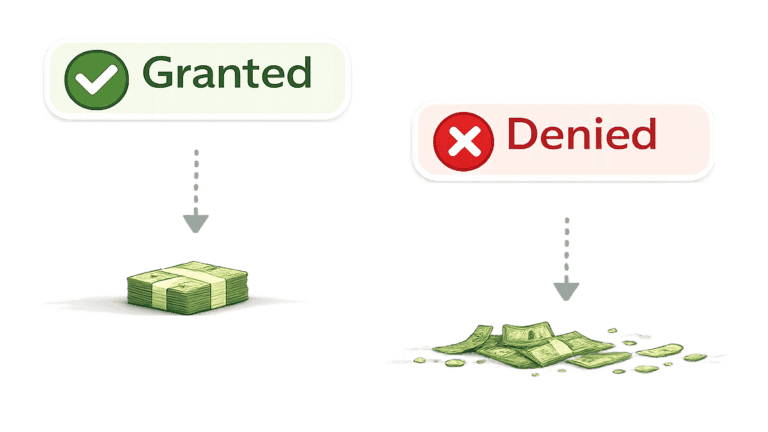
- If the user does not grant consent, identifiable data is blocked.
However, a limited signal can still be sent to analytics, after which missing data is modeled. As a result, reports contain a combination of measured and modeled data. However, modeled data is not user-level measurement but a statistical estimate of missing data.
Where should you start in a Consent Mode implementation?
Always start with the reliability of the consent signal. Ensure three things:
- Consent is transmitted correctly to analytics
- Measurement responds to the consent state technically correctly
- Modeled data entering reporting is understood correctly
Without reliable consent, reports may look normal even though some users are not recorded correctly and some results are modeled. In that case, decisions are based on a mix of measured and estimated data.
What does this mean for decision-making?
Consent Mode changes the nature of analytics, because not all data is based on directly observed measurement anymore.
When part of the data is missing and part is modeled, reports cannot be interpreted in the same way as in a situation where measurement is complete. This also affects optimization. If the underlying signal is weak, too generic, or poorly tied to business value, Consent Mode does not fix this weakness. It only changes the environment in which the signal is used. If, on the other hand, the signal is stronger and better tied to actual business outcomes, it remains more usable also in an environment where data is partly observed and partly modeled.
This is why Consent Mode belongs to the availability layer of measurement architecture: its function is not only to keep reporting usable, but also to preserve a signal suitable for optimization within privacy constraints.
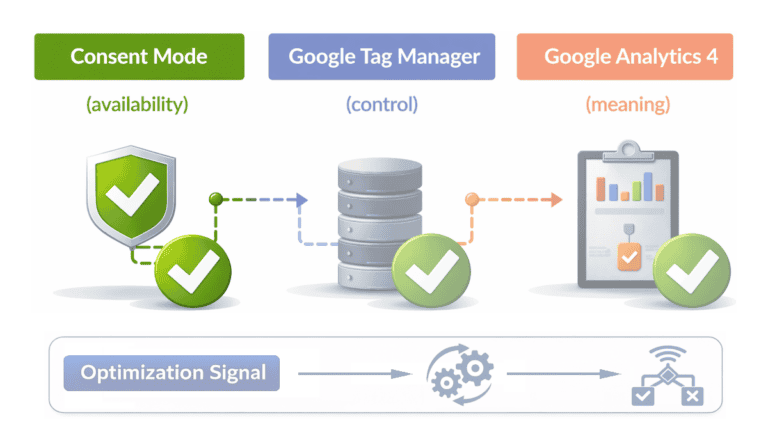
Layers of Measurement Architecture
Consent Mode (availability) → Google Tag Manager (control) → Google Analytics 4 (meaning) → optimization signal

Consent Mode – Signal availability
How to ensure data legality and model missing information

Google Tag Manager – Signal control
Signal control How to manage the technical origin and quality of data

Google Analytics 4 – Signal meaning
Signal meaning How to turn raw data into conversions and decisions
Optimization Signal
When availability, control, and meaning come together, an optimization signal is formed
The optimization signal determines what algorithms learn, what kind of traffic they begin to favor, and where budget is allocated.