
Why Google Analytics 4 Can Lead to Poor Decisions

Introduction In most companies, Google Analytics 4 appears to work as expected: data updates in real time, conversion tracking is active, and reports look clean. Yet the same measurement can still mislead decisions if it only describes what happens on the website rather than what drives real business outcomes. A technically correct GA4 setup can…
Introduction
In most companies, Google Analytics 4 appears to work as expected: data updates in real time, conversion tracking is active, and reports look clean. Yet the same measurement can still mislead decisions if it only describes what happens on the website rather than what drives real business outcomes. A technically correct GA4 setup can lead to wrong decisions when its data is used as a basis for action without understanding what it actually represents.
In this article, I explain why GA4’s default measurement is not sufficient for decision-making on its own, and how measurement needs to be restructured to support business-critical questions — especially when the same data is fed into AI systems and automated optimization in advertising platforms.
Case 01/26: 493 Key Events – Not a Single Business Outcome
Starting Point – A Real GA4 View from a Selected Reporting Period
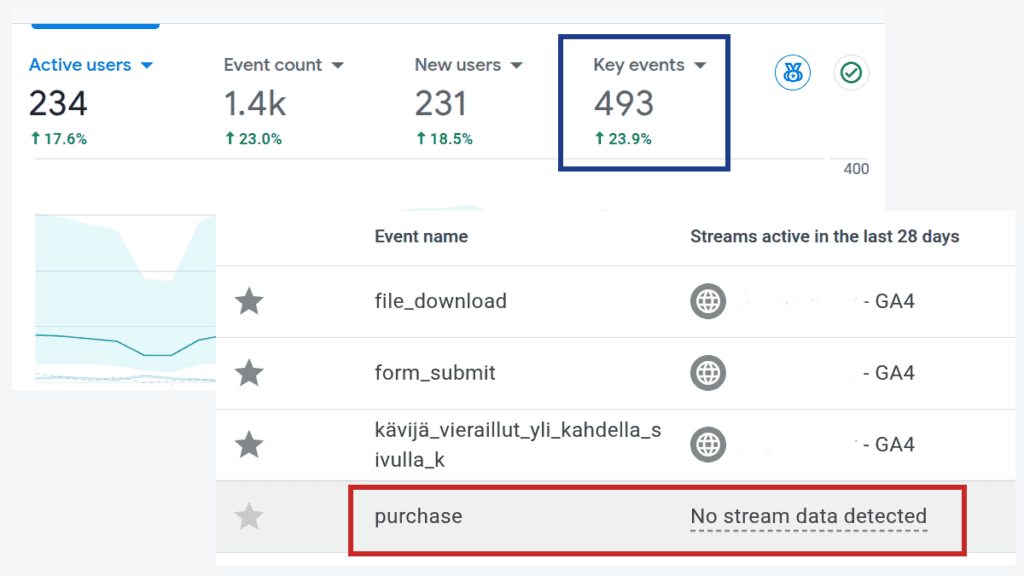
493 Key Events – Zero Measurable Sales
The Google Analytics 4 report shows 493 key events, yet no recorded sales events. In other words, GA4 conversion tracking reports 493 key events without a single measurable sale.
During the measurement period, the following key figures can be observed:
- 234 active users
- 1,400 events
- 493 key events
- 0 business events
At first glance, the numbers appear reasonably strong. Events are accumulating, and nearly 500 events marked as “key” create the impression of solid engagement. The number of users has also increased during the reporting period.
But what do these key events actually represent?
The key event list includes, for example:
- Scrolling
- File downloads
- Visits lasting more than two minutes
- Users visiting two or more pages
All of these are behavioral signals. They indicate activity, but not business outcomes. At the same time, actual business events — such as a purchase, an add-to-cart action, or the submission of a contact request — have either generated no data or have not been measured at all. The report even displays the message “No stream data detected.”
The result is technically accurate based on these metrics, yet fundamentally problematic. Google Analytics 4 can report 493 “important” events for the period, but not a single measured business outcome.
The Problem – Where Does Decision-Making Begin to Distort?
GA4 does not distinguish between activity and value. It reports both with equal weight if they are marked as key events. In this context, it is crucial to consider the nature of the events, because:
- Scrolling is not a sale.
- A two-minute visit is not a quote request.
- A file download is not a customer.
- Visiting three pages does not mean a sales inquiry.
If the key event list consists primarily of behavioral signals, analytics will begin to optimize behavior. The focus shifts toward scroll depth, session duration, and other engagement metrics — none of which directly reflect business results.
Case conclusion
When key events are built around behavioral signals, decision-making becomes anchored in activity rather than value. Marketing and optimization efforts begin to improve engagement metrics that may have little or no connection to revenue.
GA4 works exactly as it is configured to work. The issue is not the tool, but what has been defined as important to measure.
The difference is not technical — it is strategic.
GA4 Works — But does it support decision-making?
In many companies, GA4 is used largely as-is: the tracking code is in place, traffic is distributed across channels, and conversions are recorded automatically. When reports look tidy and error messages are absent, it is easy to assume that the same data is also sufficient for decision-making.
In reality, this largely automatic and free measurement system is designed to describe what happens on your website—not what actually moves your business forward. As long as measurement stays at this level, reports may look polished, but they quietly steer decisions away from the most important questions: where your best customers come from, what actions they truly take before buying, and where resources should be allocated next?
Why is the problem often looked for in the wrong place?
One misconception in analytics is the idea that if decision-making does not improve, there must be a technical fault in the measurement. People start looking for a broken tag, a missing event, or a broken installation. Technology is tweaked, views are rebuilt, and data is possibly cleaned – and after all this, decisions remain just as uncertain as before.
In most companies, Google Analytics 4 is technically in perfect condition despite everything. GA4 collects exactly the data it has been asked to collect: sessions, events, pages, and events marked as conversions. GA4 does its own job with all its parts exactly as intended.
When analytics is asked the wrong question, the answer cannot be right
The problem arises when data is used to make business decisions. At this point, one must recognize that this typical GA4 measurement is built to answer the question: “what is happening on the site?”. Decision-making, however, needs answers to different kinds of questions, such as:
- Which action brings revenue?
- Which activities consume budget without improving margin?
- Where should we invest the next coin to improve results?
GA4 measures user behavior – clicks, page loads, sessions, and events. Company decisions, on the other hand, are made based on revenue, margin, profitability, and resource allocation. Between these levels, there is inevitably a grey area that no ready-made GA4 report can fill unless measurement is consciously connected to sales and customer data in one way or another.
If the problem is sought at the technical end – tags, settings, and report views – the most essential thing is easily missed: the measurement may be in perfect condition, but it measures the wrong thing in relation to the decision being made. In this case, data can look clean and precise, but guide marketing euros and budget decisions astray because it has no direct connection to business results.
Google Analytics 4 – When Measurement and Decision-Making Do Not Meet
Let’s think about this through questions. Try answering the following:
- What part of the traffic produces genuinely good, paying customers?
- From which channel do the contact requests that lead to a deal come?
- What behavior separates a buying customer from other traffic?
- What proportion of buying customers comes through AI-driven recommendations?
If you cannot access these answers, it may be due to a lack of valuable business data or, as stated earlier, the wrong measurement point. Often these measurements and meters have not been originally designed and built to answer the questions mentioned above. GA4 does exactly what it is intended to do; it handles general tracking without a decision-making context.
Observation from practice: everything looks good – until you ask what is actually done with this
In my experience, a typical Google Analytics 4 account looks similar for many companies at the report level. There are differences in traffic volumes and differently named conversions, of course, but the measurement logic itself was defined when the account was set up, and it has not been adjusted to current business goals.
From management’s perspective, analytics often seems to be under control in these situations. Meters move, reports update, and the whole picture seems logical. However, there is a recurring pattern in these environments. When we look at measurement from a decision-making perspective, the discussion quickly drifts to the same questions.
Sales raises doubts about the quality of leads. Marketing cannot show where the best customers come from. No one dares to touch budgets because the data does not show a clear problem – but it also gives no grounds for other changes either. This situation easily forms a carousel where costs are accepted because we cannot be without them – we have to tell people we exist, after all.
At this stage of discussions, the idea often comes up that “our advertising agency handles the tracking” or “social media marketing is outsourced to a professional”. This is usually correct in the sense that measurement was installed when advertising was started. On a practical level, basic GA4 tracking is set up during implementation, and it is decided that measurement is now ready for starting advertising. Business, channels, and goals change, however, but the measurement logic easily stays at this starting point where it was originally made.
When measurement is seen as a one-time task rather than a business practice, a phenomenon is easily created where decisions are hard to make. No one really answers the question of what should be measured now so that the next decision is better than the previous one.
You can also verify this observation yourself, in your own Google Analytics 4 environment, if measurement has not been implemented based on business goals. This does not require changes; it is enough to look at current reports from a different perspective and think about what they are actually used for in the company.
Test for yourself what Google Analytics 4 tells you about your business
Open GA4 and go to the reports where traffic and conversions are typically viewed. Select Reports → Acquisition → Traffic acquisition from the view.
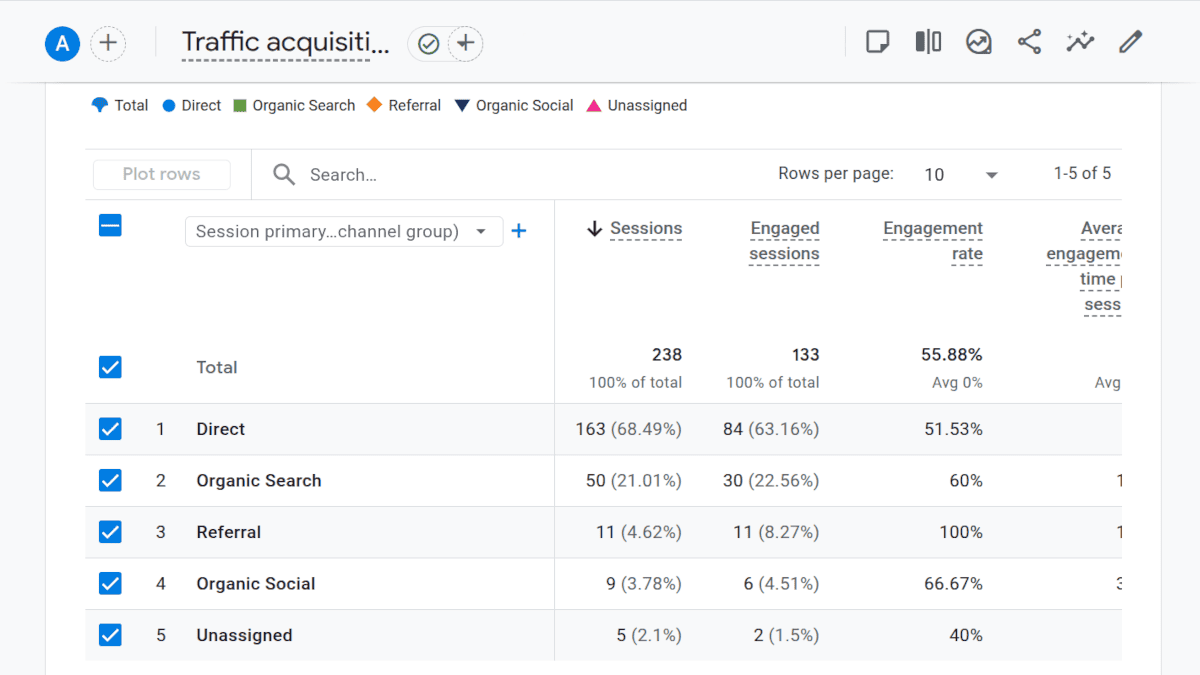
In this view, information is presented clearly. Channels stand out in order. Direct and Organic Search or Organic Social often form a large part of users coming to the page. The report clearly tells how users behave in different channels: how many there are, how long they stay, and how many events are generated. These figures are technically correct and can be trusted if the tracking installation has been done correctly and according to instructions.
When AI Makes Decisions Based on Incomplete GA4 Data
More and more often, analytics data is no longer read only by humans. It is interpreted by AI systems that power ad platform optimization, automated budget recommendations, and report summaries. These systems rely on the data collected by Google Analytics 4. AI does not understand business context; it only processes the data and signals it is given.
When GA4 measures behavior rather than business-critical stages, AI draws its conclusions from the same incomplete foundation. Modeled data, partial tracking, and conversions that do not reflect real outcomes appear to AI as facts. As a result, systems can optimize campaigns, budgets, and visibility efficiently — but in the wrong direction.
This makes measurement design more critical than ever. A flawed or business-detached measurement setup does not only lead to poor human decisions; it scales through AI into automated, continuous decisions that are rarely questioned. The more decision-making is automated, the more important it becomes to understand what GA4 actually measures correctly — and what it does not.
What should a GA4 report tell to support decision-making?
In this case, the Google Analytics 4 report fails to tell the most essential thing for decision-making. The view does not reveal which contact requests led to real sales discussions, which burdened sales unnecessarily, or which channel is genuinely most valuable from a business perspective. From this view, one cannot deduce which channel the budget should be increased for or where to cut.
The same limit is quickly met in other reports as well. When the perspective is widened, a recurring phenomenon is noticed: there is plenty of data, but information supporting a decision is left entirely outside of measurement. The report shows that events are generated, but not how these events relate to each other or which event chains lead to meaningful decisions for the business.
At this point, assess if you get answers to these or similar questions:
- Do I see which conversions or events led to a real sales discussion or deal?
- Can I separate valuable contact requests from those that never progress on the report?
- Can I tell based on the report why we should invest more in a certain channel?
For most GA4 accounts, the answer remains at least partially unclear. This is exactly what makes the observation essential: Reports are clear, but deficient for decision-making.
How to get GA4 tracking to support decision-making?
As stated earlier, Google Analytics 4 measures behavior by default, not business significance. When measurement stays at this level, data looks stable and safe, but it does not force you to question anything. This makes it surprisingly harmful for decision-making.
Meaningful data connected to business does the opposite. It not only describes the past but forces you to make choices that have real consequences for sales, budgets, and resource allocation. This brings out conflicts between marketing, sales, and decisions made, and often makes people feel uncomfortable because the information no longer supports the old story.
At the stage when analytics measures events meaningful to the business to support decision-making, it raises the question: if this is true, what should we do differently now? What should we give up? Where should we invest less, even if it feels unpleasant or even absurd?
At the stage when analytics guides you to ask “what next”, it ceases to be reporting and begins to genuinely support decision-making.
What should be measured to support decision-making?
When the difference between measurement and decision-making becomes visible, a natural question arises: what should have been measured differently? Which meter must we choose? At this point, many expect technical instructions, event lists, or new reports. But it is not primarily about measurement technology, but about the object of measurement that is chosen on business grounds.
Analytics supporting decision-making does not start with clicks or page loads, but with transitions between business events from one stage to another. In this case, focus is on points where real value, costs, or commitment are created. Simply put, it is about measurement beginning to track meaningful changes, not just behavior.
Let’s think about a few events to track and the thoughts they evoke:
- A contact request is not yet a decision, but a contact request that leads to a sales discussion is already a different matter.
- All leads are not equal, but a lead that progresses to an offer tells much more about the quality of marketing.
- A page view indicates interest, but a page view just before a contact request tells of context.
- The channel that brings the most contact requests is not necessarily the most valuable if none of them lead to a deal.
When we start measuring such transitions, reports look very different. Not because there is more data, but because it relates directly to decision-making. In my opinion, a common mistake is to imagine that a large amount of collected data will later give answers to questions. This is often not true because large amounts of data bring a lot of noise, which in turn makes managing the whole difficult. Nothing guarantees that exactly this necessary thing would be included in the measurement, even if a lot of information has been collected.
What do useful measurement points look like in practice?
When measurement begins to reflect the real stages of business, analytics no longer answers only the question “what happened on the site”, but begins to answer the question “what mattered”.
In this case, for the first time, we can see, for example:
- which channels produce leads that actually progress to sales
- which campaigns bring traffic but never lead to a deal
- at what stage interest disappears before a decision
- what kind of behavior predicts a purchase better than just visitor count
It is noteworthy that none of this requires a complex model or a huge amount of data. Often just one or two correctly chosen measurement points change the nature of reports and the support they give to the business significantly for the better.
What does Google Analytics 4 conversion tracking enable?
When measurement begins to describe decision-making and not just behavior, the role of analytics changes. It no longer acts as a justification for why no one dares to change anything, but it begins to limit options.
At this stage, the benefits of working Google Analytics 4 conversion tracking come out:
- narrows down uncertainty in budget decisions
- tells what kind of buying paths are worth focusing on
- reveals where euros should not be targeted
- makes visible what is worth giving up
- supports choices that otherwise feel too risky
Analytics still does not make decisions on behalf of the company. But it can make decisions justified. At this stage, measurement forces us to ask “what next”, at which point it ceases to be mere reporting. In this case, Google Analytics 4 reports no longer describe the past, but they help make information-based choices now and in the future.
Summary – What Follows from This?
In most companies, Google Analytics 4 appears to be working perfectly: data updates in real time, events are tracked, and reports look clean. In the example case, however, GA4 reports 493 key events and not a single measured business event. This makes the core issue visible: GA4 can show a large number of “important” events, even when none of them represent actual sales, margin, or concrete decisions.
The distortion arises because GA4 does not distinguish between activity and value. It reports both with equal weight if they are defined as key events. Scroll depth, session duration, file downloads, and event counts are behavioral signals – not decisions and not business outcomes. When the key event list is built around such signals, decision-making becomes anchored in optimizing engagement metrics that may have little or no connection to revenue or profitability.
At that point, measurement and decision-making drift apart. GA4 is built to answer the question “what is happening on the site?”, while management needs answers to questions like “what creates revenue?”, “what consumes budget without improving margin?”, and “where should we invest the next unit of budget?”. As long as measurement stays at the behavioral level, reports can look polished, but they do not reveal where the best customers come from, which paths actually lead to deals, or where spend should consciously be cut.
The risk becomes even greater when the same data is fed into AI systems and automated optimization in advertising platforms. AI does not understand business context; it only processes the signals it receives. If these signals primarily describe behavior – or modeled, consent‑driven, partial data – the system optimizes efficiently, but in the wrong direction. A misaligned measurement setup no longer leads only to weak human decisions; it scales into continuous automated decisions that are rarely challenged.
On top of this, location is not just a neutral background dimension but often a direct business driver. The very same event can have dramatically different value depending on the country, region, or city it originates from, due to margin, logistics, taxation, support costs, compliance, or market potential. If you only measure behavior without geographic context, it becomes easy to optimize traffic into the wrong places: markets that generate a lot of signals but poor margin, or regions where consent and data loss distort what you see.
Consent gaps and partial data collection also do not distribute evenly across countries and regions. In some markets, GA4 may observe far fewer events and rely more heavily on modeled signals than in others. As a result, AI and automation can start to favor locations where more signals are visible – not necessarily where the highest business value is created. Without GEO‑level checks, the system tends to optimize for “easy data”, not for the most profitable markets.
The conclusion is not that GA4 is broken. Quite the opposite: in most organizations, GA4 is technically in excellent condition and does exactly what it has been asked to do. The real issue lies in what has been defined as important to measure – and in which context those metrics are interpreted. When key events are tied to real business stages (such as qualified leads, sales discussions, quotes sent, and deals closed) and to their geographic distribution, the very same reports start to look very different: they no longer describe just what happened on the site, but which channels, campaigns, and markets are truly creating value.
Core conclusion
- Iif you measure behavior, you optimize behavior.
- If you measure business outcomes, you optimize the business.
- If you also measure where those outcomes are created, you optimize the right markets – not just bigger numbers.
Sources and references used in this article
About key events
Modeling labels for conversion value prediction
Value-based Bidding Best Practices
[GA4] Recommended events
Accessed March 19, 2026