Optimization Signals – What Algorithms Follow?
The optimization signal determines what automation treats as success. If the signal is wrong, optimization is also directed in the wrong direction.
What is the optimization signal?
The optimization signal is a measurable event or value that algorithms use for learning, budget allocation, and traffic selection. It can be, for example, a purchase, a lead, a registration, or another event that the system interprets as the desired outcome.
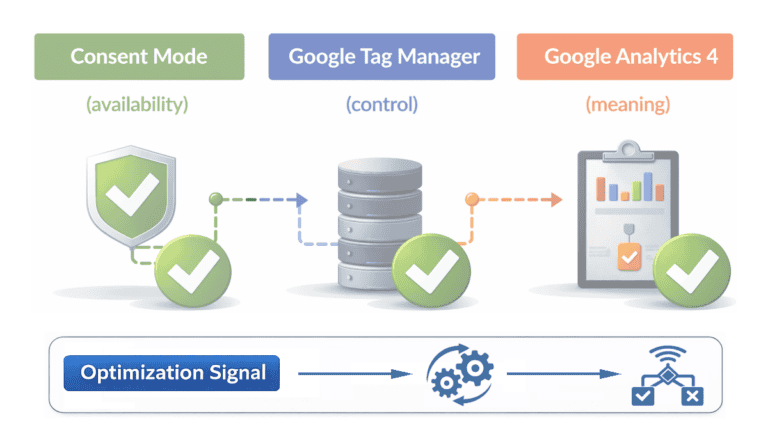
However, the optimization signal does not originate from a single tool. It is the end result of measurement architecture. Consent Mode determines how much of the signal is available. Google Tag Manager determines whether the signal forms technically correctly. Google Analytics 4 determines what the signal means and what value is assigned to it. Only after this does the signal that algorithms can use for optimization emerge.
What will you get from this page?
This page examines how the optimization signal affects automation, budget allocation, and business outcomes. The page explains what the optimization signal is, how it forms in measurement architecture, why a wrong signal steers optimization in the wrong direction, and how signal quality affects what kind of traffic the systems begin to favor. In addition, it covers practical situations where measurement looks technically correct but optimization is based on a signal that does not reflect the actual business value.
How does an optimization signal shape algorithmic behavior?
Business objective → Measurement architecture → Optimization signal → Algorithmic behavior
.Most systems work technically correctly but still optimize the wrong thing. The problem is usually not in the algorithm but in the signal. Ad platforms and automation do not understand business, margin, or customer quality. They follow the signal produced by measurement and learn to repeat what the signal defines as success.
If the optimization signal does not reflect the actual value of the business, systems begin to steer budget in the wrong direction. Reports may look clean, conversions may accumulate, and optimization may appear effective, even though the outcome deteriorates.
The optimization signal determines what algorithms consider worth pursuing.
Optimization Signal Framework
A high-quality optimization signal is not just a technically correctly measured event. The signal must also steer automation in the right direction for the business.
The optimization signal framework is based on four questions:
- Does the signal reflect actual business value?
- Does the signal differentiate users with strong and weak purchase intent from each other?
- Is the signal susceptible to noise – can the system find many “easy wins” without actual value?
- Is the signal practically optimizable – do events form with sufficient consistency and sufficient volume?
When the optimization signal meets these conditions, automation begins to favor traffic and behavior that are closer to the actual business objective. If any of the conditions is not met, systems easily begin to favor behavior that produces signal easily but does not correspond to the actual business objective.
What breaks the optimization signal?
The optimization signal breaks in practice in four ways.
- It describes the wrong outcome.
- It does not differentiate low and high purchase intent users from each other.
- It is susceptible to noise.
- It is too weak for algorithmic optimization.
As a consequence, systems begin to favor activity that produces signal most easily, not activity that produces the most business value. Optimization does not fail technically. It succeeds precisely according to the signal it has been given – but in the wrong direction.
In other words, the optimization signal breaks when measurement does not differentiate value. In that case, profitable and unprofitable activity look the same to the system. The same problem also arises when the signal describes too early a stage, too generic behavior, or just volume without a connection to the quality of the outcome.
Example: flawed signal
On many B2B websites, form submission is defined as the primary conversion. All forms are recorded as equal in value, even though their business quality varies strongly. The algorithm quickly learns what kind of traffic produces the most forms and begins to favor it.
In that case, the system may begin to emphasize users who fill out forms easily but never progress to a sale. The number of conversions grows, but the number of sales-qualified leads does not grow at the same rate. Reporting looks good, but budget begins to follow a weak signal.
Example: successful signal
The same situation can be improved by changing the optimization signal so that it differentiates quality from volume. Instead of form submission, the signal can be based on, for example, a sales-qualified lead, lead scoring, or a value that reflects the probability of progressing to a customer.
In that case, the algorithm no longer learns only who fills out the form most easily, but what kind of traffic produces better leads. The number of conversions may decrease, but budget begins to target higher-quality demand and the business outcome improves.
Optimization signal audit
You can evaluate the current optimization signal by asking:
- Do the current conversions reflect the actual business objective?
- Do the current conversions differentiate quality from volume?
- Does the system find many cheap but weak events for the signal?
- Does budget distribution change if you switch the signal to a different one?
If the answer to the last question is yes, the current signal is already steering budget, traffic, and decision-making.
Consent Mode and the optimization signal
Consent Mode directly affects the availability of the optimization signal. When not all data can be directly observed, systems must build part of the signal on incomplete data. The question is then not only how much data is missing, but what kind of signal remains available for optimization.
Consent Mode does not fix a weak optimization signal. It only changes the environment in which the signal is used. If the signal is based on early behavior, just volume, or a weak business connection, optimization is also partly based on the wrong thing even when modeled. If, on the other hand, the signal more strongly reflects value, quality, and actual progression, optimization stays closer to the business objective even in an incomplete data environment.
This is why the real question with Consent Mode is not just data volume. The more important question is whether the optimization signal in use is strong enough to withstand a partly observed and partly modeled environment.
Why is the optimization signal alone not enough for decision-making?
The optimization signal tells the algorithm what to do more of, but it alone does not guarantee that measurement is reliable. Signal quality depends on the entire measurement architecture. If data is unavailable due to consent constraints, if events form incorrectly in the collection layer, or if the meaning of conversion is defined incorrectly, the optimization signal is also distorted.
In addition, part of the data may be modeled. In that case, reporting may contain a combination of measured and estimated data. Therefore, the optimization signal should not be evaluated solely based on conversions appearing in reports. What matters is whether the signal reflects the right business outcome and whether it forms consistently across the entire chain.
Where should I start with optimization signal design?
Start from the business objective, not from the tool. The first question is not what can be technically measured, but what the systems should actually optimize.
After that, define which digital event or value describes this outcome with sufficient precision. Finally, verify that the signal differentiates profitable and unprofitable activity from each other. When these three things are in place, optimization begins to steer traffic in the right direction.
Optimization signals in production – budget, traffic, and results
In this section, I analyze situations where the structure of the optimization signal directly affects traffic quality, budget distribution, and business outcomes. In the articles, I examine how the optimization signal forms in measurement architecture, how a wrong signal steers algorithms in the wrong direction, and how changing the signal affects optimization in practice.
Layers of Measurement Architecture
Consent Mode (availability) → Google Tag Manager (control) → Google Analytics 4 (meaning) → optimization signal

Consent Mode – Signal availability
How to ensure data legality and model missing information

Google Tag Manager – Signal control
Signal control How to manage the technical origin and quality of data

Google Analytics 4 – Signal meaning
Signal meaning How to turn raw data into conversions and decisions
Optimization Signal
When availability, control, and meaning come together, an optimization signal is formed
The optimization signal determines what algorithms learn, what kind of traffic they begin to favor, and where budget is allocated.