Optimization Signals That Drive Better Outcomes

Optimization signal quality drives better results
A report can show success at the same time as the optimization signal steers in the wrong direction. The algorithm does not know the business objective directly. It learns to identify your objective based on the optimization signal that measurement architecture produces for it. A weak optimization signal can look good in a report and still weaken budget allocation, traffic quality, and business outcome. The problem is not only in the data. This article does not examine whether the event forms technically correctly…
A report can show success at the same time as the optimization signal steers in the wrong direction. The algorithm does not know the business objective directly. It learns to identify your objective based on the optimization signal that measurement architecture produces for it. A weak optimization signal can look good in a report and still weaken budget allocation, traffic quality, and business outcome.
The problem is not only in the data
This article does not examine whether the event forms technically correctly. The question is whether the chosen event should be used as a strong optimization signal.
Technically, it is possible to define nearly any event as a key event. In this article, key event means an event set as business-relevant in analytics. On the advertising side, this is referred to as a conversion that has occurred. However, the algorithm does not know whether the optimization signal fed to it measures the correct business objective. This is precisely where decision risk arises.
A weak optimization signal looks strong?
Imagine a website where an email click has been elevated as a strong optimization signal. The choice looks justified at first glance. An email click is close to a contact, easy to measure, and often higher in volume than an actual lead. Therefore it starts to seem like a practical substitute in a situation where actual contacts are few. Here lies the problem. An email click shows progression but is still clearly weaker than an actual lead.
The contradiction arises when the business objective is to get high-quality leads but measurement architecture elevates an email address click as the mark of success. A user can click the address for many reasons. They may ask a price, check contact information, start a message, or abandon before sending. They may also click an address that has nothing to do with sales at all. None of these yet means an actual lead. Still, the system begins to treat this activity as an optimization signal if it has been set in that role. At this point, the problem is not an implementation error but a classification error. The optimization signal can form technically correctly and still be the wrong measure of success.
Why does the situation look credible?
The situation looks credible for several reasons. The event logs regularly and the volume is often sufficient for reporting. Trends appear quickly and marketing channels can be compared. Ad platform models learn based on the values provided by the advertiser and use them to steer bidding. Thus it is easy to think that it would be a good enough optimization signal. When the same number appears in reporting and around optimization, it easily starts to look correct also strategically. Yet the wrong decision is often made. Volume may improve the detectability of the optimization signal but does not yet make it high-quality.
Where does the distortion form?
The actual distortion forms in what the optimization signal describes. An email click describes behavioral activity but not yet business value. As a metric, it tells about one intermediate step in practice. It does not yet tell whether the event became a lead or whether the event ever progressed to a sale. When such an intermediate signal is elevated as too strong a measure of success, the optimization signal detaches from the business objective. The report can look better precisely because the system finds more easy clicks, not because it would find more valuable customers.
Why the problem is misinterpreted
The problem is often misinterpreted because measurement appears to work on the surface. The event logs correctly. Volume accumulates in the report and comparison between channels works. Because of this, many conclude that the optimization signal is also fine. However, this conclusion is often too weak. Technical functionality and business relevance are not the same thing. The optimization signal can be wrong even when measurement is not broken.
The misinterpretation is reinforced by the appeal of volume. A weaker intermediate signal typically accumulates faster than a result that is valuable for the business. Therefore it looks more stable and more usable.
A technically advanced model does not fix a wrong optimization signal. Algorithms learn based on what is fed to them. If the optimization signal is weak or its value is poorly defined, learning also targets the wrong objectives.
How does a business objective become an optimization signal?
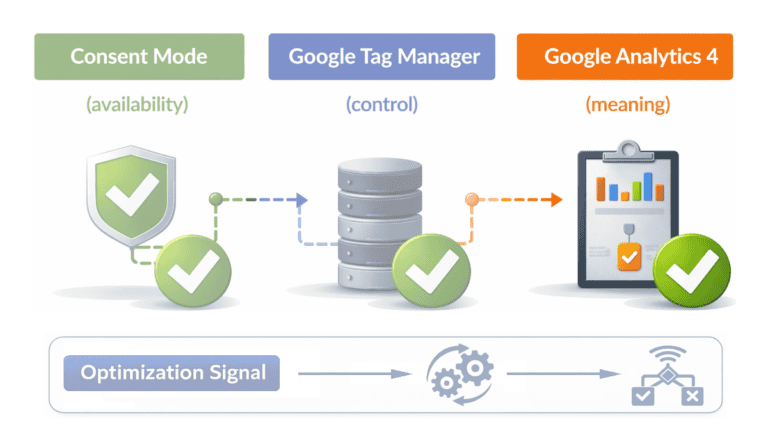
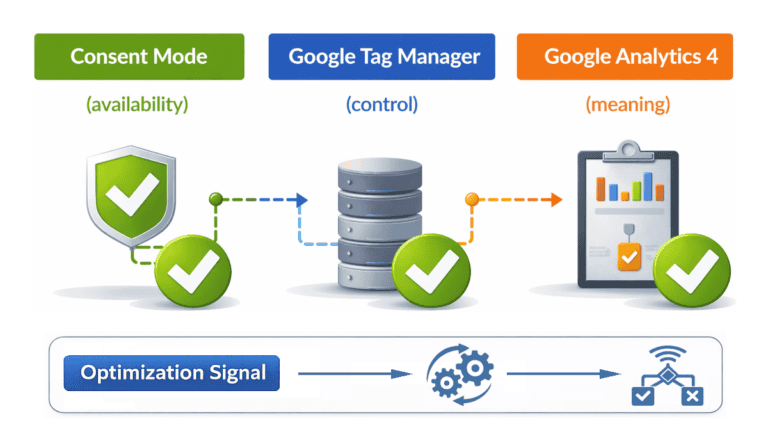
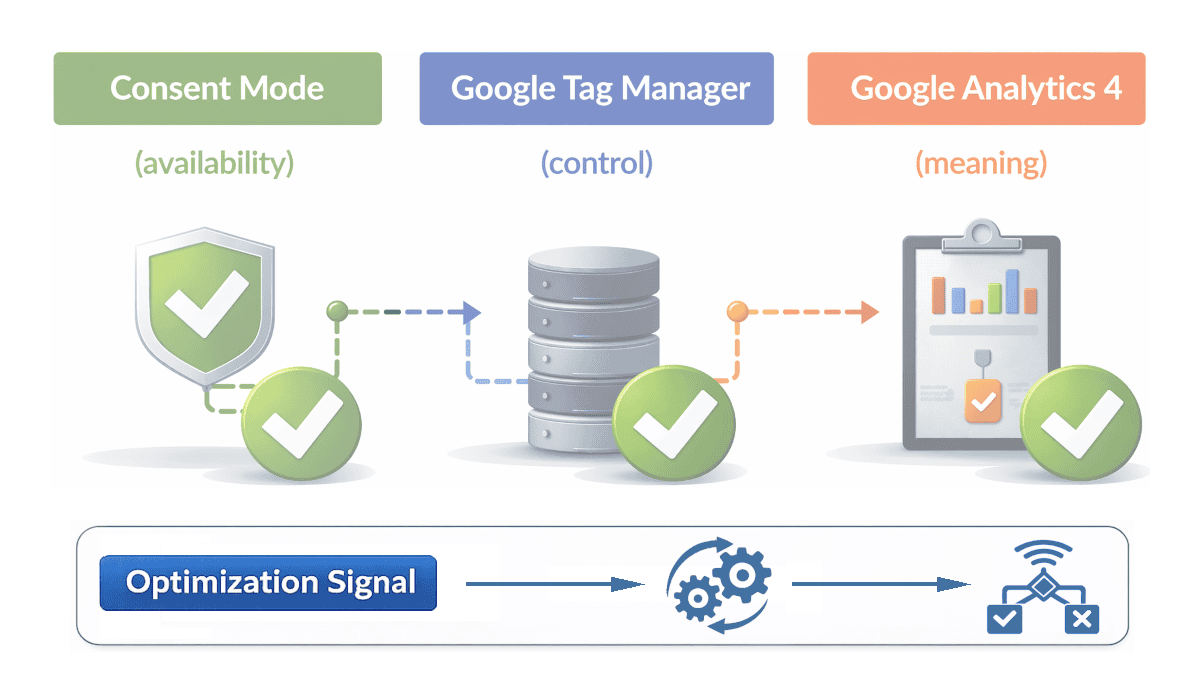
A company’s objective is to grow high-quality leads, sales, or other business value. This objective does not transfer to the system as is. It must first be converted into a measurable form. This is where measurement architecture does the decisive work. It determines what activity is tracked, at what stage it is recorded, and what value is assigned to it. This is how the business objective becomes an optimization signal that the system can use for its steering. After that, algorithmic behavior begins to favor the traffic and activity that reinforces this optimization signal.
If an email click is defined as a strong optimization signal, the system begins to treat it as success. The problem arises immediately if the business objective is a high-quality lead and not just an email link click. In that case, the optimization signal describes behavior, not yet business value. This is precisely why the problem is usually not the algorithm receiving the signal but the incorrectly defined optimization signal.
How does the optimization signal drive algorithmic learning?
When an email click serves as a strong optimization signal, the algorithm begins to learn in which situations such clicks arise most frequently. It does not learn to directly identify the best customer or the highest-quality lead. The algorithm simply learns to identify the objective it has been given. Ad platform models learn based on the values provided by the advertiser and use them to steer bidding. If these values are weak or incorrectly defined, learning is also based on the wrong starting point.
As a consequence, the algorithm begins to direct pressure toward those users, situations, and clicks that reinforce this optimization signal. The problem arises when the email click does not differentiate an actual lead from other interest. Budget begins to shift to where such clicks arise most easily. In practice, optimization becomes more precise but targets the wrong thing.
How does a weak optimization signal distort budget allocation?
Budget allocation becomes distorted if an email click is used as a strong optimization signal to steer bidding and targeting. In that case, budget begins to shift to where such clicks arise most easily. In the report, this easily appears as success, because the system produces more of the same optimization signal. The business outcome remains weak if the clicks do not lead to high-quality leads. The problem is that budget begins to follow the wrong optimization signal.
What should optimization measure?
The solution is not to add new events. The solution is to define the optimization signal so that it corresponds to the business objective. A lead pipeline is not a single event. It is a step-by-step progression of multiple events. Therefore the optimization signal must always be based on a stage that describes sufficiently strong progression or an actual end result. An email click alone is too early a signal for this. When the optimization signal is used for teaching and optimizing algorithms, it must have a value that is justified from a business perspective. Not all progression is equal in value, and not every intermediate step is a measure of success. The optimization signal works only when it measures the right stage at the right value.
Which signals are strong and which are weak?
An early signal describes behavior. An email click belongs to this group. It tells about interest but not yet about business value. A stronger signal describes progression that points to an actual lead. The strongest signal describes actual business benefit, but it typically accumulates in lower volume than early signals. A strong optimization signal does not always originate from a single event. A strong optimization signal does not always originate from a single event. It can also be formed from multiple early observations if their combination describes actual progression well enough. If an early signal is elevated too strongly, the system learns to identify interest, not business benefit. If optimization is based only on actual benefit and observations accumulate too few, learning slows down. Therefore signal strength is determined by what stage is measured, how the signal is formed, and how much usable data accumulates from it.
How do you check the quality of the optimization signal?
A weak optimization signal shows in two places. The first is measurement logic. If the optimization signal is based only on behavior and not on business value, it is too weak. The second shows in the system producing more of the same optimization signal without lead quality or sales improving. In that case, optimization is following the wrong thing.
Signal quality can be evaluated systematically by assessing its business value, intent strength, noise, usability, and reliability. A strong signal is directly connected to sales or other clear business benefit. A weak signal tells only about general activity. What is essential is what the signal actually describes and whether it can be safely used to steer algorithms.
Conclusions
Algorithms do not know the business objective automatically. They learn from optimization signals that measurement architecture forms from measurable events and their values. If this optimization signal is weak, learning also starts from the wrong starting point.
If the optimization signal describes behavior and not business benefit, the system begins to optimize behavior. In that case, the report can show success even though budget allocation begins to drift away from business objectives.
A high-quality optimization signal does not arise from high volume or easy measurability. It arises only when the signal measures the right stage at the right value. The algorithm does not learn the business objective directly. It learns based on the optimization signal that measurement architecture produces for it.
Further reading and official sources
About key events
About modeled online conversions
Modeling labels for conversion value prediction
Reaching the right customers on Search
Value-based Bidding Best Practices
[GA4] Recommended events
Accessed March 19, 2026