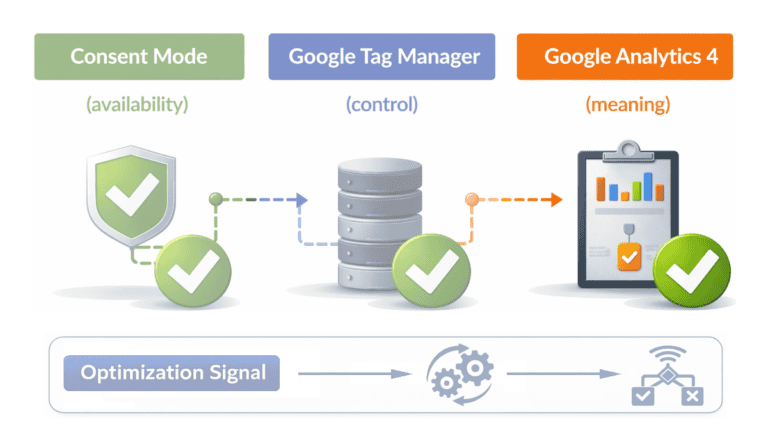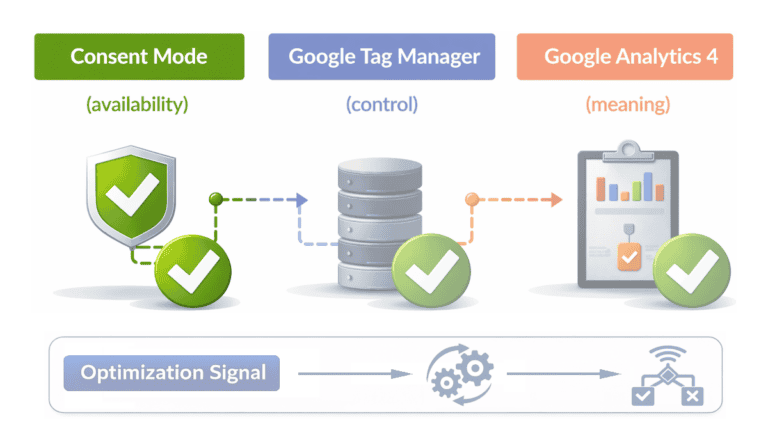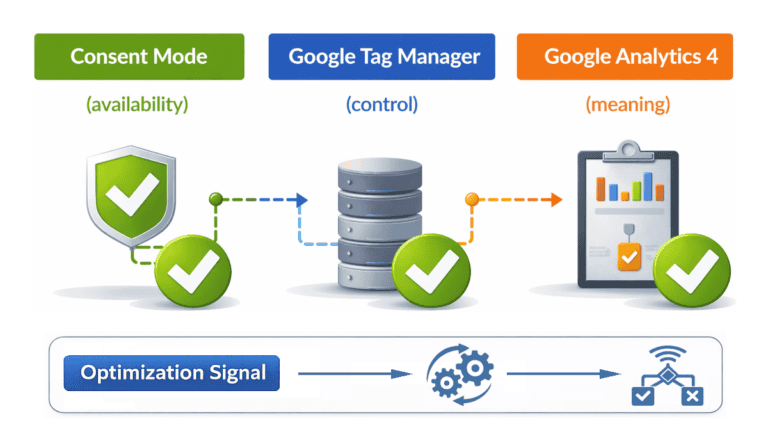
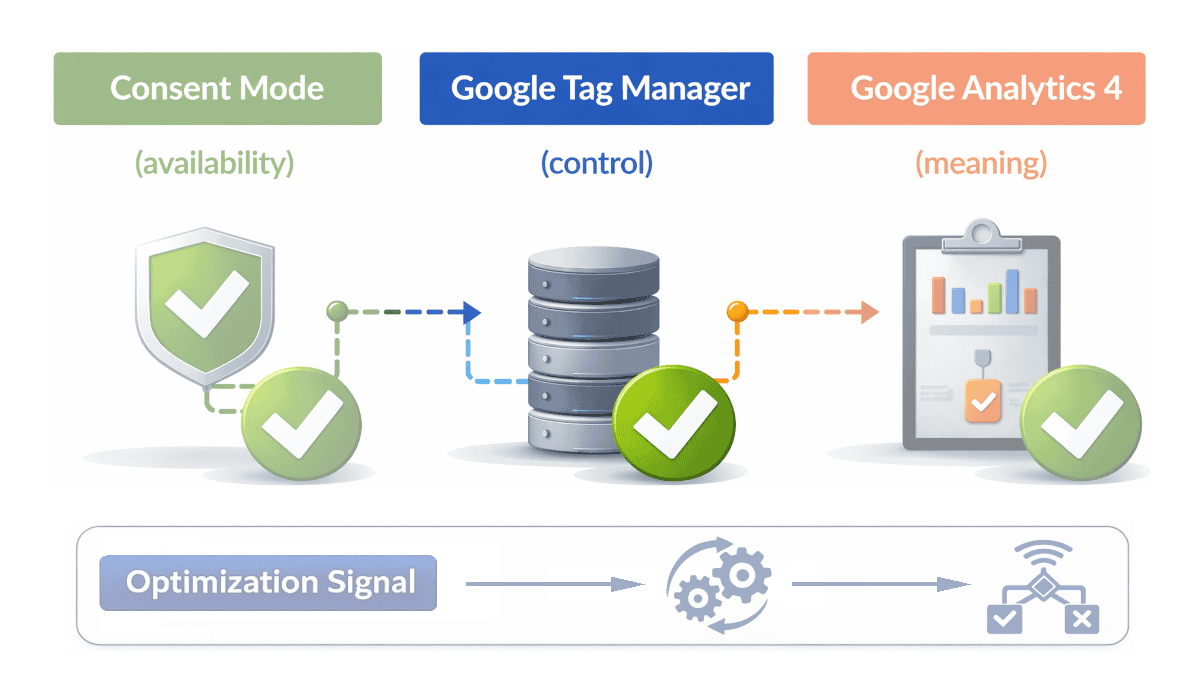
Google Tag Manager and Signal Control

Ingress Google Tag Manager (GTM) can appear technically functional even though the measurement signal is formed from the wrong event, with an incorrect structure, or multiple times. A control layer problem is often observable as a whole where one user action breaks into multiple parallel signals. This is why signal control has business significance, beyond technical functionality.
Introduction
In Google Tag Manager (GTM) implementations, tracking can appear technically functional even though the measurement signal is formed with incorrect logic. The example in this article shows the problem clearly. An email click on a contact page triggered three separate Google Analytics 4 events in GTM’s Preview view: GA4 Clicks, GA4 Click – Email, and GA4 Click – Outbound. The user performed one contact-indicating action, but the control layer produced multiple parallel signals from it. No technical error was directly visible. The actual problem was a lack of signal control.
In this article, Google Tag Manager is treated as a control layer. Its task is to determine which event the measurement signal is formed from, under which condition the tag fires, and whether the signal is generated once or multiple times. If the control layer functions poorly, the error occurs already at the stage when a user action is converted into a measurable event. In that case, the problem is not yet in analytics interpretation or reporting. The problem is in signal formation.
GTM’s technology consists of tags, triggers, variables, and the data layer. The quality of the control layer is determined by whether business-significant events are formed as a managed whole or broken into multiple overlapping or valueless events.
Starting point: one email click, three signals
The user clicks an email link on a contact page. In GTM’s preview, this action triggers three separate events (GA4 Clicks, GA4 Click – Email, GA4 Click – Outbound).
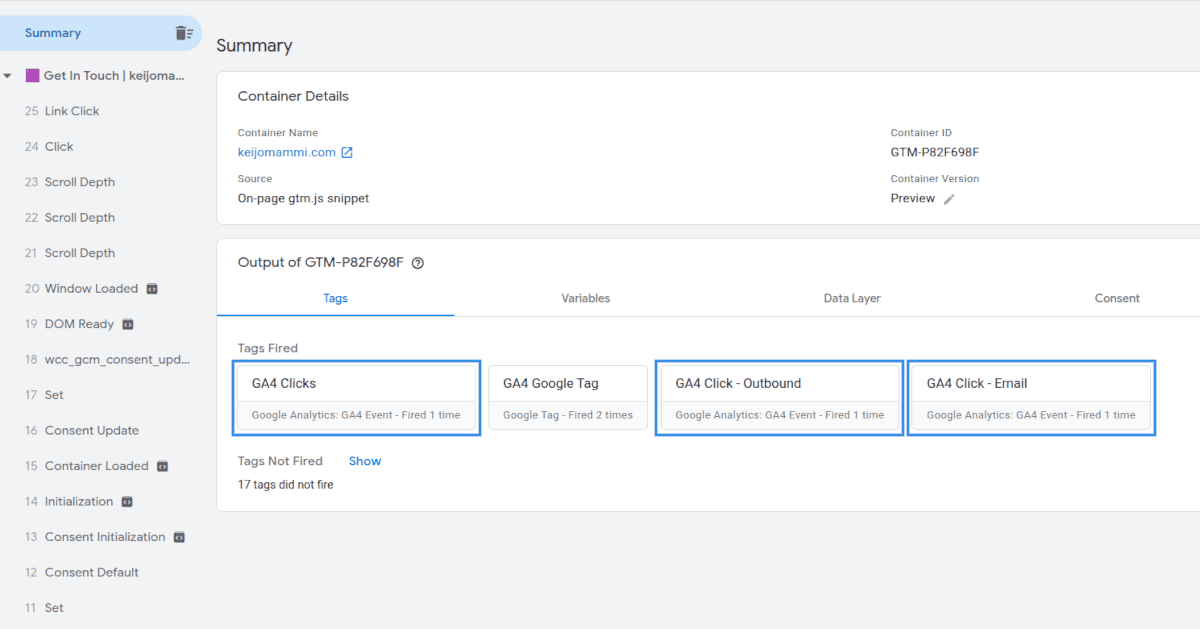
In the interface, the tags function correctly and no errors are visible in the view. The whole generally appears functional and technically credible. However, the measured event does not correspond to a high-quality measurement signal, because the email click is measured in the control layer as multiple parallel signals.
This is a typical control layer error. From the company’s perspective, measurement appears to work because the click is visible in data. A technical implementer can simultaneously confirm that tags fire at the right time. Both observations can be technically true. Yet the structure of recorded signals can be weak if one action breaks into multiple parallel events.
How is distorted measurement corrected?
Distorted measurement is corrected by changing the structure of measurement signals. One primary and clearly identifiable measurement signal must be defined for one business-significant action. In this example, the email click breaks into multiple overlapping events in the control layer. In this case, GTM does not merely pass the signal forward but also duplicates it.
The core of the correction is to separate primary-level measurement from technical supplementary data. Not all observed events belong to primary-level tracking. One event is selected as the primary measurement signal. Others remain as technical supplementary data or are removed entirely.
The situation is corrected by dismantling the overlapping trigger logic. After this, one business-significant tracking point remains for the action. Only then does one user action correspond to one measurable primary-level event.
Why the problem is often misinterpreted
Google Tag Manager-related problems are often looked for in the wrong place. When one email click appears as three separate events in Preview mode, the reaction is usually to state that measurement is at least working. Tags fire. The interface responds. Data is generated. This is why the situation easily appears as a technical success rather than a control problem.
The interpretation error is worsened by the fact that organizations often evaluate only the visible end result. If a click is visible in measurement, the implementation is accepted. If more events accumulate than before, it can even be considered an improvement. In this example case, the user performed one contact-indicating action, but GTM formed three parallel signals from it. The problem is not that data is generated. The problem is that one primary measurement signal has not been defined for one action.
This is why the problem should not be described merely as a duplicate. A duplicate is a symptom of a lack of management where one action breaks into multiple signals. The actual problem is in the structure of measurement. One primary measurement signal has not been defined for one action.
Google recommends migrating tags to GTM in a managed way. At the same time, Google states that during the transition phase, GTM can fire tags in parallel with tags still managed outside GTM. Therefore, overlapping measurement is not an exception but a practical risk, especially during the transition phase.
Google Tag Manager – control layer
In this article, Google Tag Manager is treated as a control layer. Its task is to determine whether the signal is formed in a managed way, at the right moment, and from the intended source. The usability of the signal can be evaluated, for example, with the following questions:
What data is available? Under which condition does the tag fire? What variables does the signal contain? Is the event formed once or multiple times? Is the event formed at the technically correct time?
The task of the control layer is not to collect all possible data. Its task is to delimit the action relevant for measurement and distinguish it from technical background noise. This is why measurement must be based on clearly defined information, not on interpretations picked from the page.
In this article’s example, the above questions lead to the same problem. One email click fulfills the conditions of multiple triggers simultaneously. This is why the same action is formed as a generic click, an email click, and an outbound link. The control layer no longer delimits one primary measurement signal but lets the same action through as multiple parallel events.
Server-side Google Tag Manager (sGTM) does not change this fundamental principle. The task of the control layer is still to delimit which action becomes a measurement signal and under which condition the signal is passed forward. However, sGTM can improve the preservation, enrichment, and management of permitted signal when client-side measurement loses data due to technical restrictions.
How is the signal formed?
The measurement signal is formed in stages. First, information about the user’s action is brought to the data layer. The signal thus arises from how actions are interpreted in GTM’s logic. If the required information arrives too late, the next measurement can start incomplete or with incorrect content.
A control layer error does not always originate from a trigger. It can also originate from naming. If the same information is named differently on different pages, tags do not fire consistently and the measurement signal loses its integrity.
A silent error can also occur if the data layer is overwritten with a direct assignment dataLayer = […] instead of a dataLayer.push() call. In that case, previously stored information can disappear without a visible error message, even though measurement still appears technically functional.
In this article’s example case, the email click fulfilled three different conditions. It was identified as a generic click, an email click, and an outbound link. As a consequence, one action formed three parallel signals. The error was not in an individual tag but in the fact that the same action passed through multiple measurement logics simultaneously.
A precise signal is formed only when one primary measurement logic is defined for one action. If the same action is left dependent on multiple parallel conditions, GTM no longer forms one managed signal but multiple overlapping observations of the same user action.
How a control layer error becomes a data quality problem
A management error becomes a data quality problem when an individual action no longer corresponds to one observation.
The email click in this example shows the problem clearly. When one action forms three parallel signals, measurement begins to inflate relative to actual user activity. Data quality deteriorates already at the moment of signal formation, because the measurement signal no longer corresponds to the user’s action on a one-to-one basis. As a consequence, the organization’s ability to distinguish meaningful progression from generic activity weakens.
Because the implementation appears technically functional, it may not be questioned. This is why the situation easily becomes permanent. The organization begins to trust numbers that partly contain meaningless noise produced by its own GTM structure. In that case, the problem is no longer just an individual implementation error but a permanent data quality problem.
Google also warns that the data structure used by measurement can accidentally be overwritten on top of old information. In that case, previous data can be lost. This is a good example of a silent error. Nothing necessarily appears broken, but part of the information essential for measurement disappears.
One primary signal for one action
The starting point for correction is clear: one primary measurement signal is defined for one business-significant action. In this example, three parallel primary-level events should not be left for the email click. One is selected as primary, others are excluded from primary-level measurement. The core of the correction is to dismantle the overlapping trigger logic.
Google instructs to use the same names for the same things across the entire site. If the same action or information is named differently in different places, measurement no longer functions consistently. In that case, the same customer path can appear differently at different stages and the whole becomes harder to manage.
In practice, this means that one primary interpretation is selected for the action. Is it a general click, an email click, or an outbound link? Once the selection is made, other triggers measuring the same action are removed from primary-level tracking.
If a clear measurement signal is desired for a specific action, it should not be left dependent on generic click rules. A better solution is to define the action as its own event and trigger measurement on that basis. In that case, the same action does not turn into multiple parallel signals.
How to identify a potential problem in your own environment?
A corresponding control problem can be identified in two ways. A technical implementer can check what Google Tag Manager actually does. A decision-maker can check what the same phenomenon looks like in analytics reports.
Technical check in Google Tag Manager
Open GTM Preview or Tag Assistant. Then perform one business-significant action in your own web service. A good test target is an email click, a contact form submission, or an online store order. According to Google’s documentation, Tag Assistant can be used to check the measurement state at different stages of the event chain.
After this, check two things. What events were formed? Which tags fire during the action?
In this article’s example case, one email click formed three parallel signals. If in your own implementation the same action appears as multiple parallel events, there is likely a corresponding error in the control layer. One primary measurement signal must remain for one action. When the same action triggers both a generic click tag and a specialized tag, there is overlap in primary-level measurement.
Can overlapping measurement be detected from a GA4 report?
The situation may be visible in Google Analytics 4 (GA4) reporting with a delay. Check whether the same action appears as multiple different events. Also check whether the event count appears too large. If the same action appears as multiple different events or the event count appears too large, measurement has likely broken into multiple parallel signals.
Business impact
A control layer error begins with data structure. When one action is recorded as multiple parallel signals, one user action no longer corresponds to one observation. In that case, a great deal of meaningless information, that is, noise, is recorded in measurement.
A more direct cost arises in a situation where one lead or order is recorded multiple times. Reporting then shows a better result than reality. At the same time, campaign comparison becomes distorted and optimization systems can begin using the wrong signal. At this point, the error is no longer just technical. It can directly affect where budget is directed and which campaigns are considered effective. This is why a control layer error can cause direct costs.
Conclusions
The value of Google Tag Manager is not determined by whether tags fire. The value is determined by whether one managed measurement signal is formed from one business-significant action. If the same action breaks into multiple parallel events, the error occurs already in the control layer.
In that case, the problem is not only in reporting. The data structure becomes distorted already at the moment of creation. At the same time, interpretation of measurement becomes more difficult and decision-making can begin to rely on the wrong signal.
This is why Google Tag Manager’s functionality should not be evaluated only on the basis of whether tags fire. What is essential is whether one correct signal is produced from one action. Even a correctly controlled signal is valuable only if it remains available under consent constraints.
The next question is whether that signal is also the right optimization signal.
Further reading and official sources
Consent mode overview
Get started with Tag Manager
Tag Manager consent mode support
The data layer
Accessed March 19, 2026